
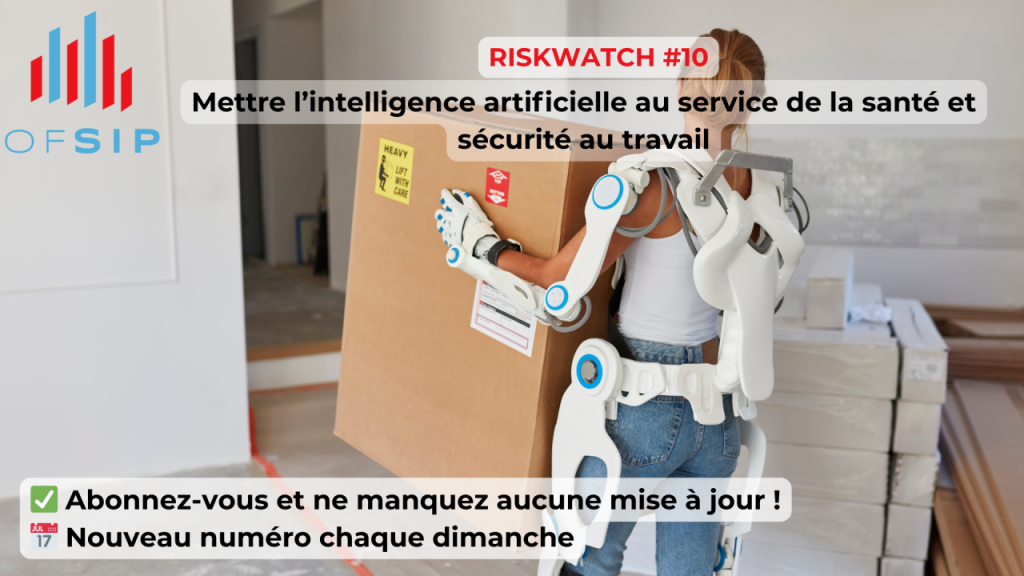
A silent revolution… but already well underway
For several years now, artificial intelligence has ceased to be an abstract concept and has become a daily reality in our professional environments. While it initially appealed to marketing or logistics departments for its massive data processing capabilities, it is now being adopted by so-called “human” functions, particularly those related to occupational health and safety. And this is very good news. Because in an increasingly complex, fragmented, and sometimes unstable world of work, prevention can no longer be content with rigid procedures or reactive measures. It must become more agile, more proactive, and better suited to the real dynamics of businesses. This is precisely where AI can play a catalytic role.
The change isn't spectacular, not yet. But it is profound. It's visible in how some companies now identify risks before they become apparent, in the tools that assist preventative measures on a daily basis, and in the new precision of field analyses. We are witnessing a silent but radical transformation in the role of data in prevention, with a promise: that of smarter safety management, serving the field rather than solely focusing on compliance.
What AI in Health & Safety Really Is
It is essential to clarify what we are talking about. Artificial intelligence, in the field of prevention, is not an autonomous machine that “thinks” or decides on its own. It is a set of technologies capable of simulating certain human cognitive functions: learning from experience, detecting patterns in large volumes of data, predicting situations, and sometimes, suggesting decisions. It is a form of ’statistical intelligence“ rather than emotional intelligence.
In practical terms, within a workplace health and safety context, this means that an algorithm can learn to recognise risky behaviour on construction site videos, cross-reference HR and operational data to identify profiles more exposed to certain disorders, or model accident scenarios from anonymised feedback. AI can also contribute to automating certain low-value-added tasks, such as documentary compliance analysis, incident report generation, or the planning of regulatory training.
It doesn't replace human expertise, but it gives the prevention officer a broader, faster, more cross-cutting view of the actual situation on the ground.
It is, in a way, a digital assistant that complements, without ever replacing, human vigilance.
Very concrete use cases
In recent years, examples of practical applications have multiplied.
In industry, certain smart cameras are able to detect in real-time the absence of PPE or intrusion into a restricted area. These systems can trigger a visual or audible alert, or even record the incident for later analysis. In logistics, sensors worn by operators allow for the detection of dangerous postures or excessively repetitive motions.
The employee receives immediate feedback via vibration or a light signal, promoting real-time self-correction.
In tertiary environments, solutions are emerging to personalise ergonomic recommendations according to the employee's profile: postural habits, time spent sitting, light exposure levels, frequency of breaks, etc. These micro-adjustments, based on concrete data, help reduce visual fatigue, musculoskeletal pain, and prevent long-term conditions.
Even in the more delicate field of psychosocial risks, AI can now analyse internal communications (while respecting GDPR), the results of anonymous surveys or behavioural signals to detect situations of tension, isolation or cognitive overload. These are not diagnoses, but tools to help identify potential issues. They enable preventative actions to be directed where the need is latent but invisible.
What the numbers say
The enthusiasm for these tools is also reflected in the figures. A PwC study (2023) reveals that 69 % of European executives believe that AI will play a decisive role in workplace safety within the next five years. Nearly half of the companies that have implemented AI solutions in health and safety report a reduction in their accident frequency rate, alongside improvements in traceability, response times and the effectiveness of targeted training.
According to EU-OSHA, organisations that incorporate predictive technologies into their HSE policy improve their ability to identify high-risk situations before they materialise by an average of 30 %.
These figures should still be taken with a pinch of salt, as they vary depending on the sectors, tools, and especially the quality of deployment. But they confirm a fundamental trend: AI is becoming a strategic tool, not just a technological gadget.
The benefits… and the limits to set
The benefits are real. AI enables continuous action, analysis of what humans cannot see or process on a large scale, and improved responsiveness without increasing human resources. It also helps to objectify certain vague or difficult-to-verbalise phenomena, such as mental fatigue, perceived pressure, or task repetitiveness.
But it would be dangerous to make AI a magic bullet. The technology only reflects what it's taught.
If the data is biased, incomplete or miscategorised, the analysis will be flawed. Worse still, if AI is perceived as a tool for control or sanction, rather than as support for prevention, it risks generating mistrust, rejection, or even additional stress. The line between intelligent assistance and unwelcome surveillance is a fine one.
Therefore, safeguards must be put in place. Ethical ones, first. Legal ones, next. But above all, human ones. A well-integrated AI is one that allows for discretion, explanation, and exceptions. The algorithm can flag, but it's always up to the human to decide.
A lever to integrate intelligently
The integration of an AI solution into a prevention policy must never be carried out as a simple tool acquisition.
This is a transformation process. It first requires identifying clear needs: reducing MSDs, improving the reliability of incident reporting, better targeting training actions, or anticipating long absences. Next, the project must be built with the right stakeholders: prevention officers, HR, HSE, operational managers, designated workers, or the employees themselves. The social acceptability of an AI tool is as crucial for success as its technical performance.
You also need to take time for testing.
Deploy on a pilot site, measure the effects, and adjust the tool to on-the-ground realities. It's not technology that should set the pace for the company; it's the other way around. Finally, and crucially: support the deployment with training. Explain the why, the how, and above all, “for whom.” If employees understand that AI is there to enhance their safety, not to monitor them, then it will naturally become a daily ally.
Conclusion: AI as an accelerator of collective vigilance
Artificial intelligence will never replace a kind look, an outstretched hand or a listening ear. It does not feel. It does not contextualise. It has no emotional memory. But it can amplify what humans do best: connect weak signals, anticipate, prioritise, act.
When well-thought-out and well-used, AI can enhance our collective ability to make prevention a strategic, agile lever rooted in reality. It can free up time, make invisible things visible, and reconcile data with practical experience.
Provided that we never forget that it is not the machine that makes the work safer. It is the intention that you put into its use.
 Français
  English (UK)
  Luxembourgish
  Deutsch