
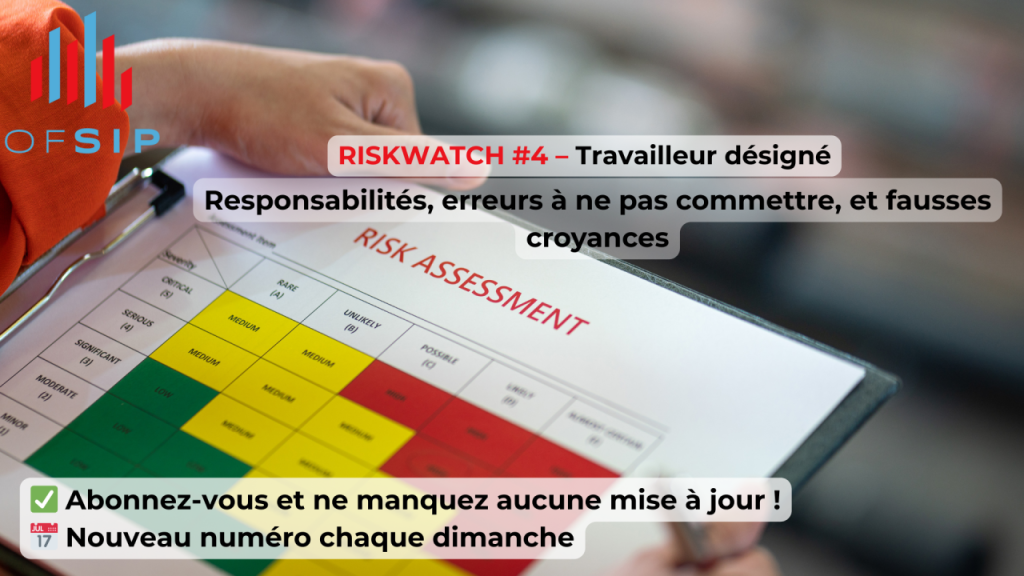
The role of the designated worker is one of the most misunderstood, yet one of the most important, within the occupational health and safety prevention system in Luxembourg. Between misconceptions, ignored obligations and minimised responsibilities, many companies are proceeding blindly... sometimes right up to an inspection by the ITM. It's time to bring some clarity to this key role.
⚖️ What Luxembourg law says
The role of the designated worker is governed by articles Articles L.312-1 to L.312-9 of the Labour Code, in connection with European Directive 89/391/EEC. In summary:
Right arrow Every employeris required to assess risks and take necessary measures to ensure the safety and health of workers.
It must Appoint one or more competent personsto manage occupational risk prevention and protection activities within the company.
These people can be in-house trained employees or competent external providers if internal resources do not allow this mission to be carried out effectively.
🔍 It's not an option. It's a Legal obligation, as has been repeatedly pointed out in the ITM reports.
According to a survey conducted by the ITM in 2023, almost 1 in 3 companies in Luxembourg does not formally designate a worker, or does not meet the minimum training requirements. And among the companies surveyed, More than 50 %s say they do not know exactly what the responsibilities of this role are.
🚨 The most frequent mistakes I observe in the field
❌ Leaving the role to the HR manager or the «default» leader without training.
Thinking that a lifesaver or safety delegate is enough to cover this role.
❌ Confusing the appointed worker with the site safety coordinator.
Do not formalise the designation in writing.
Do not tailor the skill level to the company's size and risks.
❌ Failure to anticipate absences or departures, sometimes leaving the company without anyone officially competent.
❌ Do not involve the designated worker in strategic decisions concerning development projects, procurement, or work organisation.
Result? In the event of an ITM check or an accident, the company cannot justify the implementation of its obligations. And the consequences can be serious: warnings, sanctions, or even liability in the event of a serious accident.
📚 What the designated worker MUST do (and what many overlook)
✅ Actively participate in the assessment of professional risks (physical, chemical, psychosocial, etc.)
✅ Develop, monitor and update the prevention action plan
✅ Propose appropriate preventive measures for the activity
Check the compliance of equipment and working conditions
Ensure continuous regulatory and sector-specific monitoring
✅ Participate in CSS meetings, internal audits, inspections, training
✅ To be proactive, to engage in dialogue and to be educational with management and teams
✅ Ensure the link between prevention actions, ground-level feedback, and the company's overall strategy
✅ Raise awareness and train teams, or organise external training if needed.
The designated worker is a strategic pivot between legal obligations, on-the-ground realities and the company's safety culture.
This isn't just about «following an Excel spreadsheet» or ticking boxes, but about bringing the safety approach to life in a concrete way that is integrated into daily reality.
And what about training?
The designated person must have skills required To carry out its duties. In plain English:
A Specific health and safety prevention training is essential. The level of training depends on the size of the company, its risks, and its sector.
The Grand Duchy does not set a single programme, but the expected competencies cover: risk assessment, legal obligations, accident analysis, communication and the development of action plans.
💡 What I advise my clients
- Formally appoint your designated worker (even if you go through an external provider).
- Tailor your skill level to the reality of your risks.. A 3-person office and a logistics warehouse with 40 employees do not require the same setup.
- Ensure a replacement can be mobilised In case of prolonged absence.
- Don't leave him alone. The designated worker is not there to carry all prevention alone. They are a facilitator, not a saviour.
- Press it Give them time, resources and clear hierarchical support.
- Involve him in the business strategy Security and performance are intimately linked.
✅ Do you not have a designated worker? OFSIP can support you
We intervene as External prevention provider, with:
- A clear mission, in accordance with the Luxembourg Labour Code
- Regular support in managing HSE obligations
- A hands-on, humane, and practical approach
You can also consult us to train a designated internal worker, with a programme tailored to your sector.
Our goal: for prevention to be no longer a burden, but a Sustainable added value for your organisation.
📅 See you next Sunday for the RISKWATCH number 5 : INFPC: How to prepare your training co-financing application in Luxembourg?
 Français
  English (UK)
  Luxembourgish
  Deutsch